Wednesday, March 14, 2007

Ethiopia, Starbucks and a preacher named Billy

One of the things that I've learned, since we met and adopted our daughter in Ethiopia in 2003, is that we are all implicated in what is happening in that place. Just as certainly as people are dying in mines and rebel wars in the Congo to produce the coltan and tantalum in your cel phone, so too are Ethiopian coffee farmers earning pennies on the dollar so that Starbucks can sell you a cup of Sidamo for $4.

For nearly two years now, Starbucks, one of the world's most successful corporations, has been blocking efforts by Ethiopia, one of the world's poorest countries, to trademark the names of their coffees. According to Oxfam, trademarking could help Ethiopian farmers get as much as $88 million a year more for their coffee. As one farmers' co-op in Ethiopia puts it,"We don't want help. We want a good price for the coffee."

But Starbucks wants to keep the trademark of Shirkina Sun-Dried Sidamo coffee for itself. Not because it's right, but because they can.

Enter the right Reverend Billy and the Church of Stop Shopping. Billy is the activist alter ego of Bill Talen, a preacher with little actual theological training in his past but lots of Elvis in his hips. For the past few months, Reverend Billy and his choir have been protesting Starbucks' bullying of Ethiopia by exorcising Starbucks cafes in New York City--that is to say, staging sit-ins there and then getting arrested for it.

As the Reverend puts it, he believes that "Consumerism is overwhelming our lives. The corporations want us to have experiences only through their products....But if we "back away from the product" - even a little bit, well then we Put The Odd Back In God! The supermodels fly away and we're left with our original sensuality. So we are singing and preaching for local economies and real - not mediated through products -- experience."

I've met Billy and he's a very intense (and funny) guy. He's way more righteous than me, and I don't think I could do what he has done, and give up all my transnational corporate shopping. I would also like to give you, dear reader, a well-reasoned and provocative critique of why Starbucks insists on treating Ethiopia as if it were a wealthy transnational corporation. Or at least make a good, stinging joke about their ethics. But I have to go pick up the kid at Kindergarten, and it would all boil down to this anyway:

You know what? Fuck a buncha Starbucks. I think I can quit Starbucks for awhile. Or forever.

Monday, March 12, 2007

Sunday Out


Yesterday, we took a train out to the vineyards and granite fields surrounding an old town called Eggenberg. It takes an expedition force of five adults and four children a whole day to hike a mile. Picnic lunch on a rock outcropping overlooking the fields. Nice day.

Saturday, March 10, 2007

Earth to Bennetton:


I've been walking by a jumbo poster of this Benetton advertisement for about two weeks now, both with Adinah and without her, and I'm thinking,'How the hell am I supposed to explain this to my four-year-old daughter?' Should I tell her, 'Some people don't eat enough.' Or "Some people get paid a lot of money to eat too little?' Or should I just cut to the chase? 'Well, honey, patriarchy sucks and the fashion industry is a bitch.'

Seriously.

Images like this are so everywhere that I usually have to look twice and then ask myself, 'Okay, is this worse than the rest?' And it is. These females of indeterminate age look so sick that looking at them makes me feel ill. Surely that is not the effect Benetton wants to have on it's audience.

And alright, okay, full disclosure: I'm a guy. I like skinny women. But I liked J-Lo when she was still a Chicana and she had back. I also thought Aretha was hot because she was big and she made her own clothes and she didn't give a fuck.

For some reason, this image made me think of Paul Newman. You know, the dreamiest guy that ever played a hero (until George Clooney, that is). There's a movie from the seventies where Paul Newman plays a businessman who is defamed by a well-meaning, but careless journalist, and at the end, he tells her his reputation is ruined. "And who do I talk to about that?" he says.

So it is with this picture. Who do I talk to about this? I'm not mad at the models--they're probably nice people, and they're in a f**ked up business. But please Mr. Benetton, what are you saying to my little girl? How am I supposed to explain this carrot and anorexic schtick to her?

Friday, March 9, 2007

Double Trouble

In one respect at least, Austria has a close relationship with Ethiopia. It may have started when the actor Karlheinz Bohm, best known by Americans as the cinephilic serial killer in Peeping Tom, began doing NGO work with Ethiopian children in 1981. The upshot of this is that there are two agencies in the country who are licensed to facilitate adoptions from Ethiopia, and the upshot of that is that we know several other adopted Ethiopian kids in Vienna. Lately, Adinah has grown closer to Teresa, who's one of our favorite people.

Teresa goes to the same Kindergarten, and that's great. Mostly. I sometimes suspect that Adinah and Teresa get shunted together there, even if they'd rather play with some of their other friends, because they're both little brown girls. Occasionally, some of the other parents have mistaken them for sisters, not because they look alike, but because...they're both little brown girls.

I know that's some racism right there, but I'm also learning--very slowly--that you have to pick your battles. I think we're so lucky that Adinah has a friend like Teresa in school. She tells me they draw pictures together.

Our kids are old enough to notice skin color, but they're still too young to understand subtler distinctions. In fact, most of the other kids in the Kindergarten are not from Vienna, or even from Austria. They're Serbian, or Croatian, or Turkish. Ibrahim is Egyptian, I think. But Adinah and Teresa look different. And within the Kindergarten, that's important.

Outside school, when they're with us, Adinah and Teresa are great friends. But competitive as hell. They spend a lot of time fighting about who gets the last raisin or the first gummi bear.

We went to the zoo last Sunday with Teresa, her parents and their second adopted Ethiopian daughter, Emily. It was pretty excellent. Adinah and Teresa fought over whose turn it was to ride the scooter, but they mostly had a good time. It was almost impossible to get them out of the bird house once they discovered the flamingos, whom Deanie calls "loud mingos." (Because they scream so.) Myself, I liked the orangutan who looked like Ozzie Osbourne.

Yesterday, they went to their third kids yoga class together, and afterwards, they fought like the dickens. Anette sat down next to them and said, 'Why are you guys fighting? You're best friends!' Suddenly the war was over, and they spent the rest of the afternoon giggling.

Wednesday, March 7, 2007

Hunting, Gathering


When an American moves to town, he can be cocky. At least, I was. My first job here was a revelation, and not just because I was teaching for the first time, and loving it. After so many years in New York City, I got to Vienna and suddenly realized that life and work can be quite fulfilling even if you're not living in the center of the universe. Maybe it's even better--more human--beyond the outer rim of Manhattan. The cockiness kicked in a short time later, because I thought, `Hey I'm from New York fucking City!' I thought a lot about the scene in Planet of the Apes where the astronauts land, look around at the cavemen, and say, 'Well, if this is the best they got here, we'll be running the place in six months.'

And it takes a little bit longer, but one begins to deflate a little when he realizes he lacks some basic working skills. Like being able to speak the local language.

Still later, the American starts to believe he is scurrying down the same path other expatriates took before him. 'Didja teach English at Language Borse?' 'Yeah, I did that one.' 'Try tending bar at Der Blarney Stone?' 'Yup, did that too.'

You start to think you're just not the imaginative type.

Then one day you wake up and you think, 'Judas Priest, I gotta get a job or they're gonna ship me out here for high loafing and crimes against the welfare state.'

An American friend I know here is seriously thinking about taking a job at McDonalds.

Those words have all the ominous power of an urban myth. And he knows it. He told me, 'I know it's the lowest you can go, I know it's a traitor job.' But he's got to find a way to support his family. 'One of us has got to be the guinea pig, and I guess it's going to be me.'

And I don't know what to tell him. On the one hand, I admire him for being willing to go there, to do that. I know there's lots of people all over the world who would love to have a job at McDonalds. On the other hand, I know he can do better. In America, he earned 60 to 70 grand a year making art. Here he can't find a thing. Maybe his German isn't good enough. Or maybe it's the color of his skin. I don't know.

I just hope he can hang in there a little longer.

Jeez, Mickey D's.

Saturday, March 3, 2007

Schlager and Other Delights

When I was a child of twenty-five or so, I was mortified by the phrase "world music." I got the shivers whenever I encountered the songs, album covers or physical presence of a local Austin musician named Dan DelSanto, because he was a pudgy white guy who wore a pony-tail and a Dashiki and played lame Afro-beat. I still hate the phrase, because it means nothing and it's only used by Americans to talk about music made anywhere else on the planet.

But I'll go to the barricades for international schlock. Bollywood film music, Francoise Hardy and Russian dance pop songs with choruses that sound an awful lot like "Pussy, pussy, pussy!" This is my sort of thing. There's something irresistible about hearing hundreds (or thousands) of years of another culture stuffed into the straight-jacket of major chords, wah-wah guitar solos and/or syrupy R & B cliches. International schlock is always surprising. There's always that moment when you admit, 'Alright, I would NOT have thought of running Chicago's "Color My World" over a booty beat.'


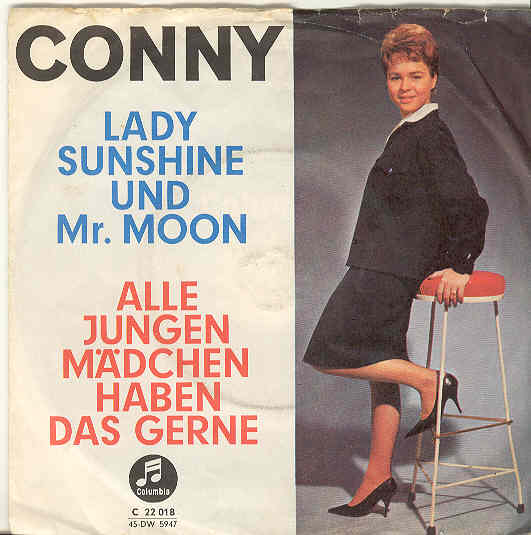
Since moving to Austria, I have discovered another strain of international schlock: vintage German Schlager. This is surrealistically upbeat schmaltz, so-named because it's like Top 40 hits made out of whipped cream. Some troubled Americans, particularly old vinyl collectors, are already familiar with one classic Schlager star, the bizarrely blonde and vaguely terrifying Heino. But there's also Gunter Gabriel, who comes off like combination of Glen Campbell and Dr. Demento, and Howard Carpendale, who sang with great phonetic enthusiasm about um, Indianapolis.

Modern Schlager is like Hootie and the Blowfish wearing Leiderhosen. But I love the fifties and sixties stuff, although it drives my wife nuts when I start moonwalking around the apartment to something like "Kriminal Tango" by the Hazy Osterwald Sextett. (She had to grow up hearing this crap on the radio after all.)

But it's not just kitschy. Schlager took off after the Second World War, and it was really the chirpy, zany flipside of Kraut Rock, a much more critically beloved genre. But whereas the acid hippies of Kraut Rock tried to deal with the horror of the war by reinventing rock music, the Schlager stars sublimated unspeakable angst and guilt by crafting the most preternaturally sunny music they could imagine.

Maybe that's why some Schlager music hangs in the air like an artificial and very strange cloud.

I like that.


Next up: the zombie prog rok of Goblin

Friday, March 2, 2007

Flashback 13

My life was not supposed to go this way.

A picture of me twelve years ago: stupid happy grin, sitting in the Mars Bar on Second Avenue, NYC, banging my head to the melodies of Lubricated Goat or some other goddamned alt-rock band, lacking the wisdom to refuse free drinks from the bartender, and only just recently sober enough to cut that ratty ponytail I'd let grow down to the middle of my back. If the barstool next to me had told me I would soon fall in love with a woman from a faraway land, I would have blinked, conjured up a vision of an Asian seductress--which were highly coveted accessories for white East Village hipster males in those days--and then I would have returned to the grinning of my grin.


I really thought I was a good dancer. I made a lot of money writing about rock stars for slick magazines. I slept with beautiful women. Someone in my position could only smirk at the prospect of hooking up with a Teutonic: German was the language of Mike Myers skits on Saturday Night Live, and "Eurotrash" was a pejorative for any young New Yorker who was truly with it. To people like me, Germans were the tightest, up-whitest people on the planet. If I had known that Austrians speak German, too--and I didn't--then I would have thought the same of them.

My prejudice, like others more and less insidious, was a lazy one. But it was also a disconnect from my life up to that minute. I'd grown up in Texas, and had defined myself by hating country music, racism and the Dallas Cowboys. As soon as I was old enough to watch public television, I fell for some of the weird old movies they would show, particularly The Cabinet of Dr. Caligari and Metropolis. When I got a bit older, I became a photographer because I saw pictures by Europeans like Robert Frank, Man Ray and Moholy-Nagy.

Austin, the most liberal town in Texas, was a good place for effete snobs, which was what I was becoming, but it wasn't old enough for me. It didn't have a real downtown, and whenever I went to towns that did, like Dallas, I mistook tall buildings for cosmopolitanism, and I swooned. All of this stuff--buildings with scars, the shadows and robots of German Expressionism, being part of a 'salon,' trading ideas about Art, and trading women too!--seemed unspeakably desirable to me. Literally unspeakable: I don't know if I ever told anyone else that I loved all this Euro-goop. It was just a lavender haze in my brain. An ideal.

Maybe Dr. Phil would say I just wanted to be someone else. But I liked myself just fine. I knew I was a suburban middle class kid, and I liked liking hard rock and pinball and the Rocky Mountains and all sorts of other goofy American shit. By the time I was twenty-five, I had even started liking country music a bit.

Then I saw New York City. I moved there a little more than a year later. I got lucky and I started writing for two dollars a word. And I stayed in New York for eighteen years.