Well, I tried out the new line yesterday. It didn't go so well.
V and Adinah and I were walking down our street, in no particular hurry. I felt good.
About twenty-five feet behind me, V. had just decided she did not feel good, and was launching a mini-tantrum. Also behind us, a little old lady with shopping bags had just passed V. and Adinah, and was approaching me with that little smile people get when they want to make contact. She looked harmless enough.
When she got to me, she looked back at the girls, who were now assaulting a coin-operated rocking horse. The lady asked, in German, 'Where is their mother from?'
So I smiled a friendly but pointed smile back, like I was about to be frank with a good pal, and I said, "That's a very personal question."
The little old lady went off. Blustering, frowning, huffing.
"That's not a personal question," she cried. "That's a normal question!"
"Do we know each other?" I asked her.
"No, I saw the children and I thought they looked like they were from Africa!"
I started to ask her why she would ask me something like that, but she didn't let me finish. Tried to ask her to be more polite, but she didn't hear me. Blustering. And mad.
So I put up my hand and walked back to my kids. And Adinah, seeing the lady making a commotion, asked, "What's she saying, Papa?"
That's when I thought I might have been wrong. I'm so tired of people asking us about us, when it's just none of their business. It's probably harmless, she's probably a nice person, but really, I'm sure she would never ask any other total stranger the same question. And I wanted her to check herself. Maybe I thought, 'Now she'll think twice before asking another family a damn fool question.'
But maybe I was only thinking of myself, and that stranger, and not of my girls. Adinah could see something had happened, could see the lady was mad at me, and that may have frightened her, or made her feel bad. That's not right, either.
It's so hard to know what to do sometimes.
Showing posts with label adoption. Show all posts
Showing posts with label adoption. Show all posts
Thursday, June 24, 2010


Tuesday, June 15, 2010
Seven Years Later
My favorite news source, besides Facebook of course, is the New Yorker. It's the best magazine. It regularly blows my brains out. And sometimes other pieces in it are just 'Meh.' I'm not sure what I think about this one, about an international adoption from Haiti.
The writer, John Seabrook, began an adoption before the horrible recent earthquakes there, then he scrambled down to the island as soon as he could to meet his daughter in the wake of the disaster. He writes that he and his wife just wanted a kid, but then it turned into a rescue mission.
I guess I'm ambivalent about this because it's a lot like our story. Our adoption of Adinah began with a lot of paperwork, a slow build of excitement, then a sudden, unexpectedly early trip to Addis Ababa to meet her. It became an emergency in our last days there, when Adinah caught pneumonia. Then just before we got on the plane home, she broke out in a rash, which we thought was maybe an allergic reaction to the anti-biotics. A few hours later we landed in London with a very sick baby. What was supposed to be a four-hour layover turned into an four day hospital stay. When one of the doctors made a "casual" remark about the unreliability of AIDS testing in Africa, we were worried sick for 24 hours as we awaited a new round of test results.
But we were all heroes, and we got through it, got home, and then we started to become a regular family. That was seven years ago.
Maybe every international adoption is an emergency. Or seems like one at the time.
These days, I forget some of what we have experienced. I think we're normal and special, but special in a regular family way. When I look at Adinah, I don't think about all the stuff in John Seabrook's article: the problems of transracial relationships, the wealth gap between Ethiopia and the US, the disasters she may have witnessed in the time Before Us. I look at her and I see my daughter. My most precious A'd.
I don't see a damsel in distress, I don't see a victim. I don't see what a stranger once told us we'd taken on--a superproject. She's not an errand of mercy. She's a little girl, and she's getting bigger all the time. I see that she has darker skin than I do, and I notice that sometimes people stare at us. But I don't repeat 'We're a normal family,' as a mantra. I don't think,'That's racist,' every time someone is mean to us.
I do grimace a little when I read an article like this about adoption, though. Journalists--even those who are adoptive parents themselves--often play up the drama and trauma and ambivalence of the experience. I know I did. But I think that what we share with all families is a lot of uncertainty. As any sort of parent, you can never be certain that your kids will be healthy, or kind, or upstanding, respectable Deep Purple fans. Nobody gets guarantees. Perhaps adoptive parents are exposed to one or two more variables, like what the NAACP or the National Social Workers guild will think about interracial adoptions five years from now when all the hubbub over Brangelina and Madonna has died down. But...who...cares?
Parenting is always a tightrope act. Look down, and you're done. Keep your eyes front--commit--and you might just be okay.
The writer, John Seabrook, began an adoption before the horrible recent earthquakes there, then he scrambled down to the island as soon as he could to meet his daughter in the wake of the disaster. He writes that he and his wife just wanted a kid, but then it turned into a rescue mission.
I guess I'm ambivalent about this because it's a lot like our story. Our adoption of Adinah began with a lot of paperwork, a slow build of excitement, then a sudden, unexpectedly early trip to Addis Ababa to meet her. It became an emergency in our last days there, when Adinah caught pneumonia. Then just before we got on the plane home, she broke out in a rash, which we thought was maybe an allergic reaction to the anti-biotics. A few hours later we landed in London with a very sick baby. What was supposed to be a four-hour layover turned into an four day hospital stay. When one of the doctors made a "casual" remark about the unreliability of AIDS testing in Africa, we were worried sick for 24 hours as we awaited a new round of test results.
But we were all heroes, and we got through it, got home, and then we started to become a regular family. That was seven years ago.
Maybe every international adoption is an emergency. Or seems like one at the time.
These days, I forget some of what we have experienced. I think we're normal and special, but special in a regular family way. When I look at Adinah, I don't think about all the stuff in John Seabrook's article: the problems of transracial relationships, the wealth gap between Ethiopia and the US, the disasters she may have witnessed in the time Before Us. I look at her and I see my daughter. My most precious A'd.
I don't see a damsel in distress, I don't see a victim. I don't see what a stranger once told us we'd taken on--a superproject. She's not an errand of mercy. She's a little girl, and she's getting bigger all the time. I see that she has darker skin than I do, and I notice that sometimes people stare at us. But I don't repeat 'We're a normal family,' as a mantra. I don't think,'That's racist,' every time someone is mean to us.
I do grimace a little when I read an article like this about adoption, though. Journalists--even those who are adoptive parents themselves--often play up the drama and trauma and ambivalence of the experience. I know I did. But I think that what we share with all families is a lot of uncertainty. As any sort of parent, you can never be certain that your kids will be healthy, or kind, or upstanding, respectable Deep Purple fans. Nobody gets guarantees. Perhaps adoptive parents are exposed to one or two more variables, like what the NAACP or the National Social Workers guild will think about interracial adoptions five years from now when all the hubbub over Brangelina and Madonna has died down. But...who...cares?
Parenting is always a tightrope act. Look down, and you're done. Keep your eyes front--commit--and you might just be okay.
Sunday, March 14, 2010
it began in Africa
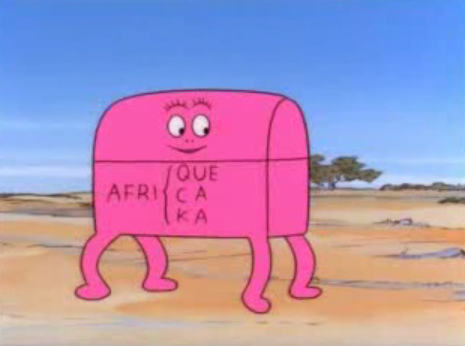
Currently, V. knows two things about Africa. It is (1) where her biological father comes from, and (2) it's where Barbapapa goes to set free all those animals he rescues from the zoo. Barbapapa being the large pink blob creature who can form himself into any shape, who always helps other creatures out, and who had his own cartoon show here in Europa in the seventies--still beloved by children of all colors.
So we do occasionally try to broaden our girls ideas about the Continent. This afternoon, we took them to a blowout organized by the local African Womens' Coalition today. It was advertised as an event celebrating Black History Month (which was last month, wasn't it?), but actually it was just a party for kids of color. Which was fine, thank you.
There was face-painting and some delicious chicken and rice, but mostly the party consisted of two very sweet (and patient) young men with dreads leading a gaggle of black, brown and caramel-colored kids in a series of games for close to five hours without a break. Including ours, the kids numbered about twenty-five at the height of the party, and ranged in age from two to twelve. Meanwhile, the parents--black, white, adoptive and/or bio--sat on the sidelines as the wild rumpus raged.
It was nice.
I think I've learned to (mostly) check my cynicism when I observe other parents, especially other white adoptive parents of brown and black kids. I try not to play Who's the Most Perfect Parent in the Room (Answer: ME!) I try not to be too over protective, nor too involved in the proceedings. I try to remember that even when the kids are dancing, nobody in the room wants to see me get funky. That would be wrong.
But still, parties like this are pretty intense. You can't make any assumptions about which language anyone does or does not speak, and it's always dicey trying to figure out which kid belongs to which big person. If you see, as I did today, a tomboyish ten year old girl who's slightly heavy, and seems to want to disappear inside her baggy clothes, and her mom, a tiny, nervous, slightly pinched and blonde woman who doesn't seem to be paying much attention to her daughter, you can't think, 'Oh, yeah, I know what's going on in their house.' But obviously, I still do.
And I have to try to set aside all sorts of self-loathing and racist poison in my brain. It's still there. Maybe it's inside of most people. All I know is I'm still working on it.
And that's nice work if you can get it.
Tuesday, March 9, 2010
bar talk

Stopped in at our former neighborhood bar last night. Stephan was working, though he told me he only works there on Monday nights these days. He’s a big handsome gym queen, and he always asks about Adinah. First he always asks, ‘What’s your daughter’s name again?’ Last night, when I walked in, he stopped talking to the young man sitting at the bar, immediately switched to English, and pumped me with so many questions about our family that I had to remind him that I had also come for a drink.
Stephan has always wanted to have a kid. Or at least, whenever he sees me, he likes to think and talk about having a kid. He seems like a sweet man. It’s probably been two years since I’ve seen him.
So last night he had lots of questions about V. ‘So she’s your foster kid?’ ‘How is that different from an adopted kid?’ ‘Is it expensive?’ ‘Is there a lot of paperwork to do?’ ‘How long did it take to get her?’ And so forth. Culminating with the last question, the one he always returns to when I return to his bar, ‘Do you think I could have a foster kid, even though I don’t have a partner?’
I told him, ‘Yes, I think you could. We know a lesbian couple who have two foster kids.’
His young friend at the bar disagreed. ‘Surely not, Stephan,” he said in German. “No way.” He said a single gay man could never become a foster father in this super Catholic country. But I began to doubt this character’s judgement over the next hour plus as I listened to him see-saw between complaining about Austrian provincialism and exhibiting it.
Mostly I was struck again by the fact that some people just want to have kids, whether or not it’s practical or even possible. Even without a boyfriend or a husband, some men think, ‘I want to be a papa.’ Women too: our friend K was like this—she was determined to adopt or become a foster parent, and when she met her girlfriend, she said, ‘Think twice before you get involved with me—I’m pregnant.’
I know this is accepted, or explained away as a ‘parenting urge’ or some such, but still I find it remarkable. In Stephan’s case, maybe it’s just a fantasy, nothing serious, not something he will ever make happen. Still, isn’t it amazing that even in these completely crazy times, some folks just want to step up to the plate and take on all this work and joy and heartbreak and other stuff?
I’m muttering again, I know, but I think that’s amazing.
Thursday, December 10, 2009
An Edition of One
In August, I wrote about beginning to put together a lifebook for Adinah. (In this post.) I used a large photo album, pictures, text, a few maps, some Ethiopian currency, an ID slip from a children's hospital and some Winnie the Pooh stickers, all to tell the story of who our daughter is and how she came to be with us. I tried to write it from her perspective, not mine (that is, I made no references to Black Sabbath or knarly skater babes.)
I finally finished it in October, and gave it to her. She really likes it.
Here's some photos. Now I've got to start making one for V.


I finally finished it in October, and gave it to her. She really likes it.
Here's some photos. Now I've got to start making one for V.
Tuesday, November 10, 2009
out of the frying pan...

Anette and I went to see the film Wüstenblume (Desert Flower) the other night. Wüstenblume tells some of the story of the Somali supermodel and human rights spokesperson Waris Dirie. Dirie, like many Somali women yesterday and today, was a child victim of genital mutilation. She fled her desert home, on foot, the night before she was to be forcibly wed to an old man. She was 13. She was lucky to survive the trek through the desert, and according to the film, when Dirie finally arrived at a road and flagged down a truck, the driver tried to rape her.
That sort of an ordeal would kill most humans, but for Dirie, things really got weird when she left Somalia. She made it to London, where she worked for a time in the Somali embassy, then she ended up homeless. Somehow she got a job in a burger joint, where she--presto!--was discovered by a famous photographer and became--chango!--a supermodel. One of Wüstenblume problems is its failure to make anything of the irony of Dirie's escape from an oppressed life in Somalia to an equally oppressive (and sick) world politely known as the "fashion industry." But I'm saving that rant for another post.
The African scenes of the film--well-acted and beautifully shot--were almost too difficult for me to watch, because I couldn't look at the screen without thinking of V. and especially Adinah. From what I know, genital mutilation is not widely practiced in Ethiopia, though it does border Somalia. But many girls in the Ethiopian countryside are married off, by the age of 6 or 7, to a boy they may think is just a playmate. As I watched the film, and especially as Anette and I walked home afterward--feeling like we'd been kicked in the teeth--I thought once again that when our girls get old enough to understand a film like Wüstenblume, we're going to have some explaining to do. Life in Africa is so different from our everyday, and the "Africa" one sees in films, TV and other media is so distorted and filtered. How will we be able to express our view of Africa to Adinah? Will she understand that despite its problems, Ethiopia is an amazing place?
Or will she think, 'Thank god Mama and Papa got me out of there?'
Or is it okay for her to think that (a little) once she understands the larger truth that we never meant to save a child? We're not hoping to win one for Western Civilization. We wanted a child. And we thought going to Ethiopia was a good way to find her.
Worse than these thoughts was the feeling I got watching the scenes of the teenage Dirie fleeing her home alone, or the scene where the three-year-old Dirie is genitally "cut." Since we became parents, movies which depict the harm or neglect of a child have become even more difficult viewing for me. I can't process this. How could a parent knowingly harm a child?
Maybe that's why I can't believe that Adinah and V.'s first parents felt any differently. Both of our daughters knew tragedy before we met them. But I feel sure that their birth parents did everything they could for their girls. I'm certain they tried to save their own children. But they couldn't.
Maybe I have to feel this way about the parents before us. I look at our kids and I think, 'They're so beautiful--how could anyone not cherish them?'
Tuesday, August 11, 2009
Representing
When she suggested it, I snarked and sneered to Anette that it might be a total sham. I made all the jokes that a seasoned (or cynical) culture industry operative should make. But of course, to prove that I'm a stand-up guy, I then agreed to it. So on Saturday, we took the kids to the Africa Days festival on the banks of the Blue Danube.
Several stages and about fifty small, turreted tents had been set up on a hot, dusty stretch of the Alte Donau, and once we got through the gate (admission: €5 before 5 pm), the first thing I saw was a table full of Obama t-shirts. These items were splashed with a picture of the Man and words he's probably never said, like "Love and Peace will triumph over Fear and Hatred." And the sweetness of that--both the shirts themselves and the possible motives of the people who were creating and selling them--this disarmed my suspicion and skepticism about Africa Days. For about thirty seconds.
It was actually a very nice event. I've always scorned white people with dreadlocks and college boys who proclaim their love of reggae music, even though all they've ever heard is Bob Marley's Greatest Hits. It's pretentious and fake and sometimes worse: some people do this sort of stuff as a way of performing "blackness," and I (still) think that's fucked up. [See: the Rolling Stones.] So as Adinah and V. and Anette and I watched the African styles fashion show, then drank mint tea at the Moroccan tent, and then watched a (great) performance by a dancing-singing-drumming troupe in tribal leopard-skin, I sneered and snarked a bit more.
So Anette let me have it.
'What's wrong with people expressing their love for a culture. Or a continent?' 'If people can't do this, then how can different people ever understand each other?' 'Why are you so suspicious?' 'If you feel this way about these white people, how will you ever be able to explain yourself to our daughter, Adinah?'
All good questions. And we were still discussing them the next night.
But when we left the Africa Days festival, a young all-white band, perhaps Austrian, was onstage, playing what sounded a lot like...ska music.
Okay, there is a real, historical connection between Jamaica and the Motherland, but Still. What the fuck was that band doing playing an African culture festival?
This is my beef: ignorance. If that band, or the event promoters, thought they should play that stage simply because they could do a passable imitation of a music style created by people with dark skin, they're idiots. That's like saying, 'I like black music.' Or 'I like Asian people.' Stoopid. Insidious.
After the festival, I thought my question for that band, and for some of the other (caucasian) people at the event, was 'What connects you to Africa?' Now I know that what I'm really asking is, 'What is my connection to Africa?' Because after all, there we were, at a festival called Africa Days. And as Anette later pointed out, this is our scene: an ersatz community of white Europeans who love African music, or to be more precise, a community of white people who love black people.
So. Is my connection to Africa more real because we've adopted one Ethiopian girl, and another who is half-Nigerian? Am I less pretentious, less guilty of fronting because I continue to listen to Deep Purple (quite frequently), instead of proclaiming my love for all things Ali Farka Toure? I don't know.
But there is a dignity in trying to be yourself, and no one else. Our last stop at the festival was a hair extensions booth. For another €5, a nice woman attached a single braid, interwoven with orange thread, to Adinah's hair. And Adinah was thrilled.
On the way out, she asked me, "Don't you want to get one too, Papa?"
"Naah," I said. "That's not my style."
Does it really need to be any more complicated than that?
Several stages and about fifty small, turreted tents had been set up on a hot, dusty stretch of the Alte Donau, and once we got through the gate (admission: €5 before 5 pm), the first thing I saw was a table full of Obama t-shirts. These items were splashed with a picture of the Man and words he's probably never said, like "Love and Peace will triumph over Fear and Hatred." And the sweetness of that--both the shirts themselves and the possible motives of the people who were creating and selling them--this disarmed my suspicion and skepticism about Africa Days. For about thirty seconds.
It was actually a very nice event. I've always scorned white people with dreadlocks and college boys who proclaim their love of reggae music, even though all they've ever heard is Bob Marley's Greatest Hits. It's pretentious and fake and sometimes worse: some people do this sort of stuff as a way of performing "blackness," and I (still) think that's fucked up. [See: the Rolling Stones.] So as Adinah and V. and Anette and I watched the African styles fashion show, then drank mint tea at the Moroccan tent, and then watched a (great) performance by a dancing-singing-drumming troupe in tribal leopard-skin, I sneered and snarked a bit more.
So Anette let me have it.
'What's wrong with people expressing their love for a culture. Or a continent?' 'If people can't do this, then how can different people ever understand each other?' 'Why are you so suspicious?' 'If you feel this way about these white people, how will you ever be able to explain yourself to our daughter, Adinah?'
All good questions. And we were still discussing them the next night.
But when we left the Africa Days festival, a young all-white band, perhaps Austrian, was onstage, playing what sounded a lot like...ska music.
Okay, there is a real, historical connection between Jamaica and the Motherland, but Still. What the fuck was that band doing playing an African culture festival?
This is my beef: ignorance. If that band, or the event promoters, thought they should play that stage simply because they could do a passable imitation of a music style created by people with dark skin, they're idiots. That's like saying, 'I like black music.' Or 'I like Asian people.' Stoopid. Insidious.
After the festival, I thought my question for that band, and for some of the other (caucasian) people at the event, was 'What connects you to Africa?' Now I know that what I'm really asking is, 'What is my connection to Africa?' Because after all, there we were, at a festival called Africa Days. And as Anette later pointed out, this is our scene: an ersatz community of white Europeans who love African music, or to be more precise, a community of white people who love black people.
So. Is my connection to Africa more real because we've adopted one Ethiopian girl, and another who is half-Nigerian? Am I less pretentious, less guilty of fronting because I continue to listen to Deep Purple (quite frequently), instead of proclaiming my love for all things Ali Farka Toure? I don't know.
But there is a dignity in trying to be yourself, and no one else. Our last stop at the festival was a hair extensions booth. For another €5, a nice woman attached a single braid, interwoven with orange thread, to Adinah's hair. And Adinah was thrilled.
On the way out, she asked me, "Don't you want to get one too, Papa?"
"Naah," I said. "That's not my style."
Does it really need to be any more complicated than that?
Tuesday, July 14, 2009
Black or White and Adinah
Three weeks ago, we were all falling asleep in a hotel room in Santa Maria Navarese, Sardinia, when CNN reported that a website was reporting that Michael Jackson was dead.
The next morning, Adinah and I woke up early, and went down to the lobby. I changed the channel on the TV there to see if it was true. Then I started trying to explain Michael Jackson to my six-year-old daughter. I’m still trying.
Actually, now Adinah is explaining Michael Jackson to me. Her favorite music video in the whole world this week is Jackson’s “Black or White.” [Ed. note: This clip is an eleven minute epic directed by John Landis, and ends with a nearly five minute segment depicting a black panther, which turns into Jackson, then back again, after a long solo dance-scream-and-smash-stuff interlude.] My wife, who introduced her Cultural Studies lecture class last week with a discussion of Jackson, found the “Bass Amplify” version of the video on YouTube and showed it to Deano. Now her favorite part is where Jackson walks through fire!
She also likes the bit where the actor John Goodman, sitting in a La-Z Boy recliner, makes a crash landing at Jackson’s feet. “I would like to come down next to Michael Jackson,” Deanie says.
“Why?” I ask.
Adinah looks at me like I’ve got cheddar for brains.
“So I could watch him dance.”
When we watch the video together, I’ve noticed that my girl sings along the loudest during the scene where Michael Jackson is perched on the torch of the Statue of Liberty. “If you're thinkin' of being my bay-bee, “ she talk-raps,”It don't matter if you're black or white!”
I wonder what those words mean to her.
Yesterday, as we were sitting at the pool watching her little sister play, Deanie asked me, “Would you think V. is black or white?”
“Hmmm, well, that’s a good question,” I answered. “V.'s first mother is white and her first father is black. That’s like Obama. His mother is white and his father is black. Do you think Obama is black?”
She thought about that for a second.
Then I said, “Maybe it’s like Michael Jackson says in the song. ‘It doesn’t matter.’ ”
I thought about that for a longer second. Then I asked Adinah, “Why did you ask that question about V.?”
“Because I was thinking that if V. is black,” Adinah said, “Then we have two black people and two white people in our family.”
So, as I interpret Adinah interpreting Michael Jackson (and the rest of the world), I guess she’s saying it does matter.
And, of course, she’s right.
The next morning, Adinah and I woke up early, and went down to the lobby. I changed the channel on the TV there to see if it was true. Then I started trying to explain Michael Jackson to my six-year-old daughter. I’m still trying.
Actually, now Adinah is explaining Michael Jackson to me. Her favorite music video in the whole world this week is Jackson’s “Black or White.” [Ed. note: This clip is an eleven minute epic directed by John Landis, and ends with a nearly five minute segment depicting a black panther, which turns into Jackson, then back again, after a long solo dance-scream-and-smash-stuff interlude.] My wife, who introduced her Cultural Studies lecture class last week with a discussion of Jackson, found the “Bass Amplify” version of the video on YouTube and showed it to Deano. Now her favorite part is where Jackson walks through fire!
She also likes the bit where the actor John Goodman, sitting in a La-Z Boy recliner, makes a crash landing at Jackson’s feet. “I would like to come down next to Michael Jackson,” Deanie says.
“Why?” I ask.
Adinah looks at me like I’ve got cheddar for brains.
“So I could watch him dance.”
When we watch the video together, I’ve noticed that my girl sings along the loudest during the scene where Michael Jackson is perched on the torch of the Statue of Liberty. “If you're thinkin' of being my bay-bee, “ she talk-raps,”It don't matter if you're black or white!”
I wonder what those words mean to her.
Yesterday, as we were sitting at the pool watching her little sister play, Deanie asked me, “Would you think V. is black or white?”
“Hmmm, well, that’s a good question,” I answered. “V.'s first mother is white and her first father is black. That’s like Obama. His mother is white and his father is black. Do you think Obama is black?”
She thought about that for a second.
Then I said, “Maybe it’s like Michael Jackson says in the song. ‘It doesn’t matter.’ ”
I thought about that for a longer second. Then I asked Adinah, “Why did you ask that question about V.?”
“Because I was thinking that if V. is black,” Adinah said, “Then we have two black people and two white people in our family.”
So, as I interpret Adinah interpreting Michael Jackson (and the rest of the world), I guess she’s saying it does matter.
And, of course, she’s right.
Saturday, December 6, 2008
Adventures in the Media Trade
So we were approached by a member of the media, a guy who's doing a story about foster parents in Vienna. We both thought it would be a good idea to talk to him. Anette wanted to try to adjust some of the wrong thinking about foster kids. As for myself, even before we met V., as we were adopting Adinah, I read a suggestion that adoptive parents should be vocal about their positive experiences, if only to counter some of the tv movie-media-horror stories about adoption. That made sense to me. So I still do take every opportunity to talk about the upside (and downside) of our family story. To everyone.
But V.'s situation is different. V.'s biological mother is alive and doing well. She reads magazines and newspapers--gosh, she might even go online sometime! That's one of the reasons I've never written V.'s full name or posted a recognizable foto of her (or Adinah) on this blog. Her first mother loves our sweet V. It's partly because of this that we were able to welcome V. into our house and have such a crazy wonderful family. We can and do thank V.'s bio-mother for that. And we owe her.
Anyhoo, the writer guy's people wanted to send a photographer to our house, but we offered to take the photos ourselves. They agreed to let us try. I made some nice, discreet pictures of Anette playing with Adinah and V. We e-mailed the pictures and the media folk were happy with them.
He came over to interview us last week. He seemed like a nice guy, seemed sensitive to the key issues, okay, good. I did get a little nervous when I saw that he wasn't gonna tape the conversation. (As a journalist myself, I almost always record interviews.) And as we talked, I paid attention to when he was listening, talking himself, and/or taking notes.
We talked about racism in Vienna, about differences between adopting and foster parenting, about some people's perception that foster parents are only in it for the state subsidies. And we talked about people who become foster parents to "save a child" or "do God's work." Let's call it the missionary position. I told the guy that I think that anyone who foster parents for this reason is gonna have problems. We told him that we adopted Adinah and brought V. into our house because we wanted to be a gang of four.
He wasn't writing much of this down.
I hope he was paying attention.
But V.'s situation is different. V.'s biological mother is alive and doing well. She reads magazines and newspapers--gosh, she might even go online sometime! That's one of the reasons I've never written V.'s full name or posted a recognizable foto of her (or Adinah) on this blog. Her first mother loves our sweet V. It's partly because of this that we were able to welcome V. into our house and have such a crazy wonderful family. We can and do thank V.'s bio-mother for that. And we owe her.
Anyhoo, the writer guy's people wanted to send a photographer to our house, but we offered to take the photos ourselves. They agreed to let us try. I made some nice, discreet pictures of Anette playing with Adinah and V. We e-mailed the pictures and the media folk were happy with them.
He came over to interview us last week. He seemed like a nice guy, seemed sensitive to the key issues, okay, good. I did get a little nervous when I saw that he wasn't gonna tape the conversation. (As a journalist myself, I almost always record interviews.) And as we talked, I paid attention to when he was listening, talking himself, and/or taking notes.
We talked about racism in Vienna, about differences between adopting and foster parenting, about some people's perception that foster parents are only in it for the state subsidies. And we talked about people who become foster parents to "save a child" or "do God's work." Let's call it the missionary position. I told the guy that I think that anyone who foster parents for this reason is gonna have problems. We told him that we adopted Adinah and brought V. into our house because we wanted to be a gang of four.
He wasn't writing much of this down.
I hope he was paying attention.
Tuesday, July 15, 2008
skin again
Most of the books we've read about it say kids don't really notice skin color until the age of five or so. And Adinah is five.
* * *
One of my secondary missions on my recent blitz trip to New York was to find some "magazines about black princesses," which was a request from Adinah and Anette. If such magazines exist, I didn't find 'em at the two large magazine stores I visited, so I got Adinah some books about powerful black girls instead. One of them, Skin Again, by bell hooks, is really more about prejudice and racism in the abstract. But I hesitated before buying it. Adinah's aware that people have different colors, but she doesn't yet know that some poo poo heads don't like people of another color. Put another way, we've talked about race, but not about racism.
I wonder when we should have that conversation.
Naturally, I'm afraid of it. Five is a tender age. What if it breaks Adinah's heart to find out just how hateful and stupid human beings can be?
She's a curious kid, though, and she's starting to ask questions. She went to a birthday party recently with her Ethiopian friend Teresa, and a couple of the other girls there laughed at them because they both have brown skin. Adinah didn't understand why anyone would laugh about brown skin.
She's mentioned it several times since then. And both Anette and I have, perhaps presumptuously, understood her to be asking a question. I told her that maybe those girls laughed because they've never seen little brown girls before. Which, in Vienna, may be true. (Of course, what I really want to say to Adinah is, 'Tell me those girls' names, and I will open up a can of whup-ass on the rednecks what raised 'em.)
But that's not even close to the whole answer to the question Adinah is asking me.
As is too often the case, I get some small inspiration from...Hollywood. I only just recently saw To Kill a Mockingbird. And when his daughter asks Atticus Finch, world's best father and all-around-too-good-to-be-true-hero, a similar question about racism, Atticus says something like, "There's a lot of bad things in the world, Scout. I wish I could protect you from all of them, but I can't."
I know it's not a perfect answer, but maybe that'll have to do for now.
* * *
One of my secondary missions on my recent blitz trip to New York was to find some "magazines about black princesses," which was a request from Adinah and Anette. If such magazines exist, I didn't find 'em at the two large magazine stores I visited, so I got Adinah some books about powerful black girls instead. One of them, Skin Again, by bell hooks, is really more about prejudice and racism in the abstract. But I hesitated before buying it. Adinah's aware that people have different colors, but she doesn't yet know that some poo poo heads don't like people of another color. Put another way, we've talked about race, but not about racism.
I wonder when we should have that conversation.
Naturally, I'm afraid of it. Five is a tender age. What if it breaks Adinah's heart to find out just how hateful and stupid human beings can be?
She's a curious kid, though, and she's starting to ask questions. She went to a birthday party recently with her Ethiopian friend Teresa, and a couple of the other girls there laughed at them because they both have brown skin. Adinah didn't understand why anyone would laugh about brown skin.
She's mentioned it several times since then. And both Anette and I have, perhaps presumptuously, understood her to be asking a question. I told her that maybe those girls laughed because they've never seen little brown girls before. Which, in Vienna, may be true. (Of course, what I really want to say to Adinah is, 'Tell me those girls' names, and I will open up a can of whup-ass on the rednecks what raised 'em.)
But that's not even close to the whole answer to the question Adinah is asking me.
As is too often the case, I get some small inspiration from...Hollywood. I only just recently saw To Kill a Mockingbird. And when his daughter asks Atticus Finch, world's best father and all-around-too-good-to-be-true-hero, a similar question about racism, Atticus says something like, "There's a lot of bad things in the world, Scout. I wish I could protect you from all of them, but I can't."
I know it's not a perfect answer, but maybe that'll have to do for now.
Sunday, July 13, 2008
(a movie about) that day

Last night, after putting the kids in bed, I watched United 93, the Paul Greengrass film about the only hijacked plane which didn't hit its target on September 11th. I'd heard it was good, I'd gotten a copy, but still I had waited until I thought I was ready to see it. Maybe I miscalculated.
Anette is out of town, and even though I was completely exhausted from chasing V. and Adinah around by myself all day, and even though I was drinking a tall boy to steady my nerves, I was twitching five minutes into the movie. After 18 minutes, I paused United 93 to catch my breath and try to stop shaking. I paused it again after 29 minutes, and then again every seven to ten minutes. It wasn't exactly suspense or excitement, but reliving the shock of that day was almost too much.
Since 2001, wherever I am in the world, and whoever I'm talking to, if the subject of 9/11 comes up, it's always the other person who's in a rush to say where they were the minute they heard what had happened in New York City. Oftentimes they say, 'I saw it happen!' and what they mean is that they saw it live on TV. But I really did hear those two booms. I really was on Pitt street on the Lower East Side on that beautiful fall morning when I looked half a mile south and saw a hole in the World Trade Center. I saw it all.
I guess it left a hole in me too.
So.
Yeah, well that was almost seven years ago.
In the apocalyptic, ohmygod days and weeks after September 11th, I decided I wanted to live. To go forward somehow. I decided I wanted to have a kid. One of the shittiest Presidents we've ever had got us into even more trouble. We went to Ethiopia and met Adinah. Then we moved to Vienna, and I wasn't sorry to leave behind a country that would re-elect a shitty President. And now I miss America, but I live in Europe, and I have a foster daughter too and I work for an NGO and help refugees because I want to live and embrace life.
I wonder where I would be if that day never happened.
Thursday, June 26, 2008
Telemarken
(Readers note: Pat Blashill is on holiday, so the Blog Drone 2000XdW has been posting a few of his old journal entries for him. This is one about his father, Donald James Blashill....)
May 25, 2004
It was the most brilliant, sky-blue day I have ever seen in South Dakota. As we drove to Wallace, the landscape became one of lunar lakes and old farms. I was sitting in the front seat with Tracy, and as the barns we were passing pulled memories out of us, we talked about the one thing I remembered most about the farm our grandmother Inga shared with our uncle Oscar: the narrow, too-steep staircase to the second floor. Somehow, even as a kid, it didn’t seem right to me—it was too tight and vertiginous. Now Tracy guessed that it felt that way because Oscar (or was it his father, Ole Lund?) had built their farmhouse himself, and so did not follow any housing codes about stair height or the rise between steps.
Inga and Oscar’s farm was out here somewhere, and my brother and I would have loved to see what my father, even though he never lived there, had called the “homeplace.” But neither Tracy nor I really believed we had the time that day.
The service at the church in Wallace was, as Tracy put it diplomatically, a little too “churchy.” Dad never believed in God or Jesus—I think he thought religion was a con. His wife Maria sat next to us in the front pew, and I was afraid to think that she, deep in her grief, was being made more unhappy by the preacher’s talk of resurrection and the flower that blooms from the mortal body. As it turns out, she later sobbed that she believes all that stuff, she just was finding it hard to believe that day. But it was what it was. My aunt and uncle had arranged for it, and the service no doubt gave them some comfort. My own beliefs about religion are a more vague-less angry echo of my fathers’ skepticism. I started crying anyway.
Afterwards, I needed to get out. I took Adinah out the back door and she toddled happily through the grass behind the church as I held her tiny brown hand.
She found a small, smooth stone that she liked, and I put it in my pocket to keep for her. As I was kneeling beside all the parked cars with my daughter, my great uncle Hank Riggenholt walked up the sidewalk. Hank just turned ninety, and I only recognized him because I’d heard that he’d fallen down recently and had two black eyes (the back story: he was walking out of the restaurant where he gets his lunch sometimes and he tripped and fell face first onto the pavement. He broke a small bone in his nose, scratched up his glasses too, but he was so hungry, he sat up, afraid that he’d crushed his lunch, then opened it up and ate it before he went to the doctor).
So Hank hunches up to me and asks to meet “Donnie’s” wife. I take him over to Maria, who’s only slightly weeping at the moment. Hank shakes her hand, and then he says,
“You know, Donnie always sent me grapefruit.”
Maria, well aware of how much this bent-over farmer of the northern plains always loved getting those big pink fruits from the sunlands, began to sob again. A few more fat tears squeezed out of my eyes, and I clutched Adinah closer to me. Hank, having nothing better to say, and feeling damn awkward, receded.
We all climbed in our cars, and drove to the old Norwegian church that was one of my father’s favorite places. It’s an extremely simple and somehow awesome building—although maybe it seemed so formidable, even eerie to me because as we turned up the dirt road and the white wooden spire came into view, Telemarken loomed less like a real place and more like a figure re-emerging from the grainy composite of dreams and old photographs some of us call memory.
We didn’t go inside: the church is only ever open for services on Memorial Day weekend. Instead, the preacher, my cousin Sherry and her kids, my cousins Lynn, Barry and Danny, my aunt Helen and her Ronny, my uncle and his Evelyn, Maria and her brother Arturo, Tracy, my wife, my daughter and I all walked out into the middle of the cemetery surrounding the church. As I glanced around at the black granite headstones (RIGGENHOLT, LUND, FJELSTAD, BLASHILL) I realized I knew a large share of the people who are buried there. The clouds above were thin, pretty curves, like clouds in a painting. Pheasants were calling to each other all around us.
Someone had dug a perfect twelve by twelve inch hole next to my fathers’ parents graves, and after he recited some familiar verse that no one was listening to, the preacher told Maria she was supposed to put my father right there in that neat little hole. For the first and only time that weekend, Maria expressed an opinion: she said no. Her Don, my dad, their Donnie—he wouldn’t have wanted to be dumped into a perfect hole.
So, after her weeping subsided a little, and she caught her breath, Maria opened that little brown case that she had been clutching to her chest for the last two hours, opened the plastic bag inside, and took out a handful of the light grey ashes that were once my father. She threw them carefully across the ground behind James and Inga Blashill’s graves. Then she took another handful of ashes, moved away a bit and threw it out into the air and over the dirt of Telemarken. I was standing downwind, and some of my fathers’ ashes drifted into my eyes, my nose, my clothes. Maria wandered out through the cemetery, flinging the ashes across the grass and the graves; Arturo followed behind her, holding the box of my fathers remains. A lot of us were crying again—Anette grimaced as if she couldn’t stand to see me in this kind of pain—but Adinah was just wandering around, climbing on top of headstones. I gathered her up and showed her how to blow the fuzz off of a dandelion. And when Maria had finished, I hugged her. She was still sobbing, and through my own tears, I choked the words, “That was so beautiful, Maria.”
After awhile, everyone filtered back into their cars and left. Tracy, Anette, Adinah and I stayed back to visit a couple more graves. I hovered at the headstone of my great grandmother Tomine: Dad had always said that Tomine, who had come to America as an arranged bride for our great grandfather, Ole, was so unhappy that she watered her rose garden with her own tears. I picked a little yellow flower from the grass that grows over Tomine now, then we got in the rental car and drove back to our hotel in Sioux Falls, South Dakota.
May 25, 2004
It was the most brilliant, sky-blue day I have ever seen in South Dakota. As we drove to Wallace, the landscape became one of lunar lakes and old farms. I was sitting in the front seat with Tracy, and as the barns we were passing pulled memories out of us, we talked about the one thing I remembered most about the farm our grandmother Inga shared with our uncle Oscar: the narrow, too-steep staircase to the second floor. Somehow, even as a kid, it didn’t seem right to me—it was too tight and vertiginous. Now Tracy guessed that it felt that way because Oscar (or was it his father, Ole Lund?) had built their farmhouse himself, and so did not follow any housing codes about stair height or the rise between steps.
Inga and Oscar’s farm was out here somewhere, and my brother and I would have loved to see what my father, even though he never lived there, had called the “homeplace.” But neither Tracy nor I really believed we had the time that day.
The service at the church in Wallace was, as Tracy put it diplomatically, a little too “churchy.” Dad never believed in God or Jesus—I think he thought religion was a con. His wife Maria sat next to us in the front pew, and I was afraid to think that she, deep in her grief, was being made more unhappy by the preacher’s talk of resurrection and the flower that blooms from the mortal body. As it turns out, she later sobbed that she believes all that stuff, she just was finding it hard to believe that day. But it was what it was. My aunt and uncle had arranged for it, and the service no doubt gave them some comfort. My own beliefs about religion are a more vague-less angry echo of my fathers’ skepticism. I started crying anyway.
Afterwards, I needed to get out. I took Adinah out the back door and she toddled happily through the grass behind the church as I held her tiny brown hand.
She found a small, smooth stone that she liked, and I put it in my pocket to keep for her. As I was kneeling beside all the parked cars with my daughter, my great uncle Hank Riggenholt walked up the sidewalk. Hank just turned ninety, and I only recognized him because I’d heard that he’d fallen down recently and had two black eyes (the back story: he was walking out of the restaurant where he gets his lunch sometimes and he tripped and fell face first onto the pavement. He broke a small bone in his nose, scratched up his glasses too, but he was so hungry, he sat up, afraid that he’d crushed his lunch, then opened it up and ate it before he went to the doctor).
So Hank hunches up to me and asks to meet “Donnie’s” wife. I take him over to Maria, who’s only slightly weeping at the moment. Hank shakes her hand, and then he says,
“You know, Donnie always sent me grapefruit.”
Maria, well aware of how much this bent-over farmer of the northern plains always loved getting those big pink fruits from the sunlands, began to sob again. A few more fat tears squeezed out of my eyes, and I clutched Adinah closer to me. Hank, having nothing better to say, and feeling damn awkward, receded.
We all climbed in our cars, and drove to the old Norwegian church that was one of my father’s favorite places. It’s an extremely simple and somehow awesome building—although maybe it seemed so formidable, even eerie to me because as we turned up the dirt road and the white wooden spire came into view, Telemarken loomed less like a real place and more like a figure re-emerging from the grainy composite of dreams and old photographs some of us call memory.
We didn’t go inside: the church is only ever open for services on Memorial Day weekend. Instead, the preacher, my cousin Sherry and her kids, my cousins Lynn, Barry and Danny, my aunt Helen and her Ronny, my uncle and his Evelyn, Maria and her brother Arturo, Tracy, my wife, my daughter and I all walked out into the middle of the cemetery surrounding the church. As I glanced around at the black granite headstones (RIGGENHOLT, LUND, FJELSTAD, BLASHILL) I realized I knew a large share of the people who are buried there. The clouds above were thin, pretty curves, like clouds in a painting. Pheasants were calling to each other all around us.
Someone had dug a perfect twelve by twelve inch hole next to my fathers’ parents graves, and after he recited some familiar verse that no one was listening to, the preacher told Maria she was supposed to put my father right there in that neat little hole. For the first and only time that weekend, Maria expressed an opinion: she said no. Her Don, my dad, their Donnie—he wouldn’t have wanted to be dumped into a perfect hole.
So, after her weeping subsided a little, and she caught her breath, Maria opened that little brown case that she had been clutching to her chest for the last two hours, opened the plastic bag inside, and took out a handful of the light grey ashes that were once my father. She threw them carefully across the ground behind James and Inga Blashill’s graves. Then she took another handful of ashes, moved away a bit and threw it out into the air and over the dirt of Telemarken. I was standing downwind, and some of my fathers’ ashes drifted into my eyes, my nose, my clothes. Maria wandered out through the cemetery, flinging the ashes across the grass and the graves; Arturo followed behind her, holding the box of my fathers remains. A lot of us were crying again—Anette grimaced as if she couldn’t stand to see me in this kind of pain—but Adinah was just wandering around, climbing on top of headstones. I gathered her up and showed her how to blow the fuzz off of a dandelion. And when Maria had finished, I hugged her. She was still sobbing, and through my own tears, I choked the words, “That was so beautiful, Maria.”
After awhile, everyone filtered back into their cars and left. Tracy, Anette, Adinah and I stayed back to visit a couple more graves. I hovered at the headstone of my great grandmother Tomine: Dad had always said that Tomine, who had come to America as an arranged bride for our great grandfather, Ole, was so unhappy that she watered her rose garden with her own tears. I picked a little yellow flower from the grass that grows over Tomine now, then we got in the rental car and drove back to our hotel in Sioux Falls, South Dakota.
Tuesday, June 24, 2008
Flashback: The subway singer
(Readers note: the guy who types Euro Like Me has skipped town, so the Blog Drone 2000XdW will be posting a few of his old journal entries for him. I'd like to dedicate this one to Stacy, wherever she may be....)
March 1, 2004
Two weeks before Christmas, Adinah and I were swimming upstream against a tide of Manhattanism in the Thirty-Fourth Street F station. She was asleep and strapped into the stroller, I was on foot and on edge. Somehow through the crush of people, I heard some street musicians flirting with the beginning of a tune I thought I recognized. Let’s stop and listen, I thought.
The singer was a pretty black girl—twenty-two maybe, long straight hair, wearing jeans, a sweater, black suspenders, and a smile as big as Brandy’s. She was working a tough crowd. Hardly anyone had stopped to listen to her, but she was thanking everyone within hearing range anyway. Upbeat and invulnerable, she paced the dank concrete floor of the station, and started into Christina Aguilera’s “You Are Beautiful.”
The casual reader will be aware of this song—a stoopidly catchy teen power ballad allegedly about being freakish—and may, as I do, believe that it sounds sorta perverse (and patronizing) coming out of the mouth of a tiny millionaire and former Mouskateer who is currently working a look best described as skank `ho at a piercing convention. Coming from a Barbie doll diva who has simply changed her style while she continues to broadcast the blur of melisma and kiddy-porn music critics call “teen pop,” “You Are Beautiful” is less a hymn to non-conformity than a rationalization of Xtina’s latest makeover. I’m saying.
But the subway singer crooned it defiantly at the indifferent mass rushing by her, as if she was singing it to herself, a mantra she repeated to keep herself warm. She was weaving gold out of garbage, until “You Are Beautiful” was.
I pulled the stroller over, unzipped her day-glo pink snowsuit a little and woke Adinah. I wanted her to see this strong black heroine singing her heart out. I thought, “This is what I want Adinah to remember about New York and her time here.” The poetry of the scene—the frenzy of the crowd, the unrequited tenderness in the singer’s voice, the faint light in Adinah’s waking eyes—everything fused together. Then the cast of characters got transposed and I was singing to Adinah,
“ ‘Cuz you are beautiful
In every single way.”
I love this city and I love the life I’m living and I love this little girl and all the beauty that seems to just blossom around her.
March 1, 2004
Two weeks before Christmas, Adinah and I were swimming upstream against a tide of Manhattanism in the Thirty-Fourth Street F station. She was asleep and strapped into the stroller, I was on foot and on edge. Somehow through the crush of people, I heard some street musicians flirting with the beginning of a tune I thought I recognized. Let’s stop and listen, I thought.
The singer was a pretty black girl—twenty-two maybe, long straight hair, wearing jeans, a sweater, black suspenders, and a smile as big as Brandy’s. She was working a tough crowd. Hardly anyone had stopped to listen to her, but she was thanking everyone within hearing range anyway. Upbeat and invulnerable, she paced the dank concrete floor of the station, and started into Christina Aguilera’s “You Are Beautiful.”
The casual reader will be aware of this song—a stoopidly catchy teen power ballad allegedly about being freakish—and may, as I do, believe that it sounds sorta perverse (and patronizing) coming out of the mouth of a tiny millionaire and former Mouskateer who is currently working a look best described as skank `ho at a piercing convention. Coming from a Barbie doll diva who has simply changed her style while she continues to broadcast the blur of melisma and kiddy-porn music critics call “teen pop,” “You Are Beautiful” is less a hymn to non-conformity than a rationalization of Xtina’s latest makeover. I’m saying.
But the subway singer crooned it defiantly at the indifferent mass rushing by her, as if she was singing it to herself, a mantra she repeated to keep herself warm. She was weaving gold out of garbage, until “You Are Beautiful” was.
I pulled the stroller over, unzipped her day-glo pink snowsuit a little and woke Adinah. I wanted her to see this strong black heroine singing her heart out. I thought, “This is what I want Adinah to remember about New York and her time here.” The poetry of the scene—the frenzy of the crowd, the unrequited tenderness in the singer’s voice, the faint light in Adinah’s waking eyes—everything fused together. Then the cast of characters got transposed and I was singing to Adinah,
“ ‘Cuz you are beautiful
In every single way.”
I love this city and I love the life I’m living and I love this little girl and all the beauty that seems to just blossom around her.
Sunday, June 22, 2008
Flashback: We meet!
(Readers note: the old #@!#! who writes Euro Like Me is drunk again, so the Blog Drone 2000XdW will be posting a few of his old journal entries for him. Beware! The following post contains moments of unabashed sentimentality and next to no clear thinking: journey back with us now, to the day we met our daughter....)
July 30, 2003
Before we saw her, I was so anxious, I felt breathless. During our time together in that yellow orphanage office, underneath the framed picture of Jesus and the words ‘Confio et Mi’, time fell away, the skies opened up and poured, and I felt like white light—every color of the spectrum, full ablaze at the same time.
Afterwards, as I sat on the floor of the German Mission, furiously scribbling and slightly drunk on Ethiopian red wine—I felt pulled in every direction by a roulette wheel of thoughts that were bigger than my ability to think them. In my journal, I could only scrawl, “Adinah Rosa exists! She is a tiny, pretty, big-eyed, long-lashed dynamo who wants to talk even though she doesn’t have language yet. She looks all around and she looks out the window—she’s wondering, ‘What’s out there? And who are you?’”
They brought her in while I was autographing a vast sheath of adoption papers. Naturally, I was asking what these papers were, and I was requesting English translations of them, and I was otherwise acting on the Good Advice of everyone who ever told me anything about the way the world works. Suddenly, one of the younger sisters from the orphanage brought in a baby and handed her to Anette, and everything went Rosa. Then I was holding her up in the air—an amazing human airplane!!--and her little face and her big eyes cracked just slightly, so barely, into a smile. It was a smile which seemed to say, “Okay.”
My eyes blurred. I handed her back to Anette and signed the rest of the goddamn papers.
Sister Deherika and the other women cleared out of the room. So did the men, except for a guy with a large boom box who just sat in the corner, rewinding and fast-forwarding a cassette tape of Ethio-pop music until it sounded like the Chipmunks doing all your Amharic faves! Then he left too, and Anette and I were all alone with the little jewel who was to be, apparently, our first daughter.
We must have stayed in that office for four hours. Our driver, Zerihun, came back to pick us up twice: we told him we wanted to stay with Adinah Rosa a little longer. Outside, the heavy clouds burst, and the skies hurled big buckets of rain at the concrete playgrounds of the orphanage. The door to the courtyard was wide open, but the nuns left us alone—besides, anyone attempting to cross the grounds and come back inside our room would have been drenched. I thought the storm had exploded right outside our new family just so the world would go away for a minute, if not exactly stop.
Anette held Rosa in her arms. I held her, too. Anette walked with her; I kissed her on the head and cheek. She liked tugging at the gold heart which hung from a chain around Anette’s neck. She liked it when I burrowed my nose into her neck and squealed “Eeegi-eegi buggi-boo!” She liked it when we lifted her up so she could fly and swing and twirl in the air like a freestyle astronaut.
We took a lot of photographs. We even gave Ms. Adinah Rosa a bottle of formula. Then she upchucked all over Anette. We could feel her heart beating fast, so Anette laid little Adinah across her knee. And the baby, despite an interest in Everything, fluttered her eyes, and slowly, slowly, finally fell asleep. When we switched places, Adinah Rosa, now sleeping across my legs, barely stirred. Anette laid her head on my shoulder and in a few minutes, we were all asleep--together again, at last, for the first time.
July 30, 2003
Before we saw her, I was so anxious, I felt breathless. During our time together in that yellow orphanage office, underneath the framed picture of Jesus and the words ‘Confio et Mi’, time fell away, the skies opened up and poured, and I felt like white light—every color of the spectrum, full ablaze at the same time.
Afterwards, as I sat on the floor of the German Mission, furiously scribbling and slightly drunk on Ethiopian red wine—I felt pulled in every direction by a roulette wheel of thoughts that were bigger than my ability to think them. In my journal, I could only scrawl, “Adinah Rosa exists! She is a tiny, pretty, big-eyed, long-lashed dynamo who wants to talk even though she doesn’t have language yet. She looks all around and she looks out the window—she’s wondering, ‘What’s out there? And who are you?’”
They brought her in while I was autographing a vast sheath of adoption papers. Naturally, I was asking what these papers were, and I was requesting English translations of them, and I was otherwise acting on the Good Advice of everyone who ever told me anything about the way the world works. Suddenly, one of the younger sisters from the orphanage brought in a baby and handed her to Anette, and everything went Rosa. Then I was holding her up in the air—an amazing human airplane!!--and her little face and her big eyes cracked just slightly, so barely, into a smile. It was a smile which seemed to say, “Okay.”
My eyes blurred. I handed her back to Anette and signed the rest of the goddamn papers.
Sister Deherika and the other women cleared out of the room. So did the men, except for a guy with a large boom box who just sat in the corner, rewinding and fast-forwarding a cassette tape of Ethio-pop music until it sounded like the Chipmunks doing all your Amharic faves! Then he left too, and Anette and I were all alone with the little jewel who was to be, apparently, our first daughter.
We must have stayed in that office for four hours. Our driver, Zerihun, came back to pick us up twice: we told him we wanted to stay with Adinah Rosa a little longer. Outside, the heavy clouds burst, and the skies hurled big buckets of rain at the concrete playgrounds of the orphanage. The door to the courtyard was wide open, but the nuns left us alone—besides, anyone attempting to cross the grounds and come back inside our room would have been drenched. I thought the storm had exploded right outside our new family just so the world would go away for a minute, if not exactly stop.
Anette held Rosa in her arms. I held her, too. Anette walked with her; I kissed her on the head and cheek. She liked tugging at the gold heart which hung from a chain around Anette’s neck. She liked it when I burrowed my nose into her neck and squealed “Eeegi-eegi buggi-boo!” She liked it when we lifted her up so she could fly and swing and twirl in the air like a freestyle astronaut.
We took a lot of photographs. We even gave Ms. Adinah Rosa a bottle of formula. Then she upchucked all over Anette. We could feel her heart beating fast, so Anette laid little Adinah across her knee. And the baby, despite an interest in Everything, fluttered her eyes, and slowly, slowly, finally fell asleep. When we switched places, Adinah Rosa, now sleeping across my legs, barely stirred. Anette laid her head on my shoulder and in a few minutes, we were all asleep--together again, at last, for the first time.
Friday, June 20, 2008
Flashback: Sugar C. Jones
(Readers note: the lovable hairdresser who writes Euro Like Me is abroad, so the Blog Drone 2000XdW will be posting a few of his old journal entries for him. So sit back and cool yr. heels: This is a little flashback to the bureaucratic labyrinth behind our big fat international adoption....)
May.14.2003
Sugar C. Jones.
Voice like a tarpit. Lime sherbet polyester pantsuit. Blond middle-aged dreads. But before I actually saw her, I saw her nameplate—itself approximately sixty-five years-old, made of rubber, plastic and glue, like a chipped relic from a film noir movie--sitting amongst the tilting piles of her desk. Sugar C. Jones. But that's Mrs. Jones to you, pal.
In the middle of my paperwork day, as two simple tasks multiplied like a root system, and I realized that, in addition to catching a three A.M. bus to Washington D.C. for a visit to the Ethiopian Embassy and the US State Department, I would also need to send a fax and a Fed Ex package to Texas, make two visits to the New York County Clerk's office, another to the fingerprint crew over at One Police Plaza, set up a last minute rendezvous with our American social worker (whom I would then walk over to a notary to get a signature, another stamp and a seal,) then visit the New York Secretary of State, the Treasury Department, and the Authentication Section of the DC Office of Homeland Security--in the middle of this ratpath without-a-breadcrumb-trail, I found myself sweating from the forehead, perhaps only seconds away from going into a full-body twitch, and staring at yet another paperpusher who was telling me that my documents were not only not in order but that they were pretty much meaningless. And her name was Sugar. Sugar C. Jones.
"You'll have to separate these papers," Sugar was saying, her fingers folding and spindling my delicately bound and sealed adoption dossier, "And you have to get your social worker to notarize this form before I can authenticate it. You'll have to take this other form back to 1 Police Plaza, have one of the three supervisors over there resign it at the bottom, then bring it back to me. And you'll have to separate these papers."
"Wait a second," I sputtered, "Why do I have to go over to the Police Department again--this is an original and official document, and they've already signed it! I was told you would just notarize these papers and then I could take them to--."
"I don't notarize documents, I authenticate them."
"Wha-? I don't, I…?"
"I can only authenticate the notarization of notaries who are qualified with a stamp for New York County to notarize county documents for authentication. This, and this--matter of fact, a lot of these other documents are gonna have to be notarized and authenticated before you take them to the Secretary of State."
"I'm sorry," I whimpered, my head descending into my hands, "Could--could you please be careful with that--we paid a lot of money to have those documents bound like that…."
"Just a minute," Sugar C. Jones said, storming off with my dossier.
For a second, I thought she'd gone to get security. Somewhere back in the dizzy murk of my brain, it was beginning to dawn on me that the pantsuited Mrs. Jones was a steel wall.
She came back with her superviser, a man with a yellowish tie and a haircut and a head that somehow made me think, 'Rutabaga.' "He doesn't want to separate these documents," Sugar was telling this turnip man.
He didn't really tell me anything different, except that if I would go away and get all the necessary stamps and signatories on the relevant papers, then come back again, he and Sugar might be able to authenticate them without cutting the thin peppermint-striped string and paper seals which bound the dossier. Somehow this felt like a détente.
As I gathered up my documents and started for the door, Sugar C. Jones was still shaking her head and croaking, "I've never seen papers tied up in a book like that before."
May.14.2003
Sugar C. Jones.
Voice like a tarpit. Lime sherbet polyester pantsuit. Blond middle-aged dreads. But before I actually saw her, I saw her nameplate—itself approximately sixty-five years-old, made of rubber, plastic and glue, like a chipped relic from a film noir movie--sitting amongst the tilting piles of her desk. Sugar C. Jones. But that's Mrs. Jones to you, pal.
In the middle of my paperwork day, as two simple tasks multiplied like a root system, and I realized that, in addition to catching a three A.M. bus to Washington D.C. for a visit to the Ethiopian Embassy and the US State Department, I would also need to send a fax and a Fed Ex package to Texas, make two visits to the New York County Clerk's office, another to the fingerprint crew over at One Police Plaza, set up a last minute rendezvous with our American social worker (whom I would then walk over to a notary to get a signature, another stamp and a seal,) then visit the New York Secretary of State, the Treasury Department, and the Authentication Section of the DC Office of Homeland Security--in the middle of this ratpath without-a-breadcrumb-trail, I found myself sweating from the forehead, perhaps only seconds away from going into a full-body twitch, and staring at yet another paperpusher who was telling me that my documents were not only not in order but that they were pretty much meaningless. And her name was Sugar. Sugar C. Jones.
"You'll have to separate these papers," Sugar was saying, her fingers folding and spindling my delicately bound and sealed adoption dossier, "And you have to get your social worker to notarize this form before I can authenticate it. You'll have to take this other form back to 1 Police Plaza, have one of the three supervisors over there resign it at the bottom, then bring it back to me. And you'll have to separate these papers."
"Wait a second," I sputtered, "Why do I have to go over to the Police Department again--this is an original and official document, and they've already signed it! I was told you would just notarize these papers and then I could take them to--."
"I don't notarize documents, I authenticate them."
"Wha-? I don't, I…?"
"I can only authenticate the notarization of notaries who are qualified with a stamp for New York County to notarize county documents for authentication. This, and this--matter of fact, a lot of these other documents are gonna have to be notarized and authenticated before you take them to the Secretary of State."
"I'm sorry," I whimpered, my head descending into my hands, "Could--could you please be careful with that--we paid a lot of money to have those documents bound like that…."
"Just a minute," Sugar C. Jones said, storming off with my dossier.
For a second, I thought she'd gone to get security. Somewhere back in the dizzy murk of my brain, it was beginning to dawn on me that the pantsuited Mrs. Jones was a steel wall.
She came back with her superviser, a man with a yellowish tie and a haircut and a head that somehow made me think, 'Rutabaga.' "He doesn't want to separate these documents," Sugar was telling this turnip man.
He didn't really tell me anything different, except that if I would go away and get all the necessary stamps and signatories on the relevant papers, then come back again, he and Sugar might be able to authenticate them without cutting the thin peppermint-striped string and paper seals which bound the dossier. Somehow this felt like a détente.
As I gathered up my documents and started for the door, Sugar C. Jones was still shaking her head and croaking, "I've never seen papers tied up in a book like that before."
Wednesday, June 18, 2008
Flashback: notes from an adoption
(Readers note: the rumpled brainiac who writes Euro Like Me is on holiday, so the Blog Drone 2000XdW will be posting a few of his old journal entries for him. So sit back, and get out your handkerchiefs: This is a little number from our earliest days as adoptive parents-to-be....)
april 18 2003
On the phone all day: with the State Department, with the former INS--now known as the Bureau of Citizenship and Immigration Services, with international adoption advocates and other strangers, and all of the sudden, as I sit at my computer, half-reading the Ethiopian government's requirements for adopting a child in their country, I get to a line about how all the court documents in Addis Ababa, where we will be adopting our daughter, have to be translated out of Amharic and into English, and I start crying. Like a big baby.
I'm not even sure why. Something about that word "Amharic," and its place in this sentence that I am reading, this information that I will soon be using to take a child away from everything Amharic and Ethiopian and African to come live with me and Anette as our little girl, something in the tragedy and miracle of that fact hits me. Hits me now, and that's strange: we've been working on this adventure for a few months now, but it's only real to me in flashes like this.
And the flashes are overwhelming: I think about how hurt and sad we were when we tried to make a baby, in-vitro styley, this summer and it didn't work; I think about how fucked up it is that all them kids in Addis Ababa don't have parents; I imagine a slim Ethiopian woman in a light brown wrap--fuck, I don't even know what Ethiopians call their clothes--hurrying through the city with a baby, thinking back about all the things she wishes, all the reasons she can't keep the little girl in her arms, all the things that put her in this place, and I imagine her setting that baby down on the steps underneath a statue, in a public park somewhere in the City, a place that's not too crowded but not too deserted either, a place where she knows her child will be found.
Maybe she leaves the park, maybe she walks to a spot a couple of hundred yards away, so she can watch and make sure someone picks up her baby and takes her to a policeman. Think about the people there in the park, who see the woman come in, and maybe they've seen this so many times they know that she's there to leave her baby behind; think about the person who finds this little girl, a couple of months old, if that, laying wrapped in a blanket in a cardboard box, crying for someone, someone who might help.
I don't out and out sob, I just cry in little jags. Once I know it's coming, I give up reading the State Department web page, and just give myself over to it by putting on some old Fairport Convention (which will make me cry almost any day) and getting out our travel guide to look at the people and places in that land. I find myself apologizing to the Ethiopians in the pictures, not because I feel guilty that we may take one of their daughters away from them, but more because I'm thinking something like: "I'm sorry the world is like this."
april 18 2003
On the phone all day: with the State Department, with the former INS--now known as the Bureau of Citizenship and Immigration Services, with international adoption advocates and other strangers, and all of the sudden, as I sit at my computer, half-reading the Ethiopian government's requirements for adopting a child in their country, I get to a line about how all the court documents in Addis Ababa, where we will be adopting our daughter, have to be translated out of Amharic and into English, and I start crying. Like a big baby.
I'm not even sure why. Something about that word "Amharic," and its place in this sentence that I am reading, this information that I will soon be using to take a child away from everything Amharic and Ethiopian and African to come live with me and Anette as our little girl, something in the tragedy and miracle of that fact hits me. Hits me now, and that's strange: we've been working on this adventure for a few months now, but it's only real to me in flashes like this.
And the flashes are overwhelming: I think about how hurt and sad we were when we tried to make a baby, in-vitro styley, this summer and it didn't work; I think about how fucked up it is that all them kids in Addis Ababa don't have parents; I imagine a slim Ethiopian woman in a light brown wrap--fuck, I don't even know what Ethiopians call their clothes--hurrying through the city with a baby, thinking back about all the things she wishes, all the reasons she can't keep the little girl in her arms, all the things that put her in this place, and I imagine her setting that baby down on the steps underneath a statue, in a public park somewhere in the City, a place that's not too crowded but not too deserted either, a place where she knows her child will be found.
Maybe she leaves the park, maybe she walks to a spot a couple of hundred yards away, so she can watch and make sure someone picks up her baby and takes her to a policeman. Think about the people there in the park, who see the woman come in, and maybe they've seen this so many times they know that she's there to leave her baby behind; think about the person who finds this little girl, a couple of months old, if that, laying wrapped in a blanket in a cardboard box, crying for someone, someone who might help.
I don't out and out sob, I just cry in little jags. Once I know it's coming, I give up reading the State Department web page, and just give myself over to it by putting on some old Fairport Convention (which will make me cry almost any day) and getting out our travel guide to look at the people and places in that land. I find myself apologizing to the Ethiopians in the pictures, not because I feel guilty that we may take one of their daughters away from them, but more because I'm thinking something like: "I'm sorry the world is like this."
Friday, April 25, 2008
my cool family top ten, Week of April 21

1) The way V. woke up this morning, held out her arms for a hug, and laid her head on my chest. Then bolted upright, looked at me very seriously and said, "Quargrum korum, quarum," as is she was telling me, "Actually, there is a difference--an important one--between lo-fat and no fat."
2) The way my wife evaporates problems, bitch-slaps challenges and re-edits her Power Point presentation in twenty minutes, with both kids screaming, while wearing those giant sunglasses and looking hot.
3) The way that Adinah beats me so efficiently and constantly at Uno, Mensch Argert Mich Dich (sort of the German Parcheesi) and Homer Simpson Memory, and then dances around the room yelping "I am the Champions, I am the Champions."
4) The way V. rolls into a room with absolute authority, even though she still falls down a lot.
5) The way Adinah looked from the back as she wobbled away from me, really riding a bike for the first time.
6) The fact that no matter how crazy busy and stressed out she may be, Anette puts it aside so we can all be together on Sunday.
7) The way V. sits in her hi-chair with pieces of rice in her hair and throws her head back and laughs, as if the only way to laugh is to laugh with your entire body.
8) The scientific experiments Adinah is conducting in the swing we've hung from our living room ceiling. (The latest project: can she write her name and play air cello while spinning around counter-clockwise and swinging back and forth?)
9) The way that Anette gets so excited whenever she goes to Caritas to buy used furniture or shoes for V.
10) The way that Adinah refers to whichever kid she played with today as her Best Friend.
Saturday, March 22, 2008
A week with the In-laws
Anette has gone to the USA for ten days to work on a film project, but I haven't been home alone with the kids. Oma and Opa were here to help.
Previously, when my wife went away for work or play, I dreaded the extra papa duty a little, but I also liked being the Boss around here finally. My schedule, my rules, my food, my black metal on the stereo. But this week I wasn't in charge at all. Oma did her best to dominate the kitchen area as soon as she arrived, and Opa's ridiculous shenanigans with the kids really overwhelmed my efforts to be the Dad Who Plays the Most. It's amazing what sort of child entertainment value that eighty-year-old kid can squeeze out of a blank piece of paper and a pair of scissors.
The kids had a great time. Adinah sat at the kitchen table drawing with Opa a lot, and Oma occasionally chased V. around the house, a game which makes our second daughter chuckle so hard she hiccups. One night I was folding clothes in another room, and I started to hear all this maniacal laughter from the next room. When I walked around the corner, all four of them were shuffling around a pile of pennies on the table, and cackling as if they had just invented the most naughty form of amusement known to man.
Oma, a.k.a Teresa, and Opa, also known as Josef, met each other and got married more than fifty years ago: he had fought for the Germans on the front lines, then became a POW, while she stayed home and tried to survive in a tiny farm town in Austria. The first time they saw white bread, they were astounded. A few days ago, I was making us some lunch, and I asked Opa if he would like some shrimp. He said he'd never eaten one.
So it's sort of amazing for me to watch them cavorting around our big city apartment sixty years later with their Ethiopian and half-Nigerian grandaughters. Could they have ever imagined their twilight years would look like this?
Previously, when my wife went away for work or play, I dreaded the extra papa duty a little, but I also liked being the Boss around here finally. My schedule, my rules, my food, my black metal on the stereo. But this week I wasn't in charge at all. Oma did her best to dominate the kitchen area as soon as she arrived, and Opa's ridiculous shenanigans with the kids really overwhelmed my efforts to be the Dad Who Plays the Most. It's amazing what sort of child entertainment value that eighty-year-old kid can squeeze out of a blank piece of paper and a pair of scissors.
The kids had a great time. Adinah sat at the kitchen table drawing with Opa a lot, and Oma occasionally chased V. around the house, a game which makes our second daughter chuckle so hard she hiccups. One night I was folding clothes in another room, and I started to hear all this maniacal laughter from the next room. When I walked around the corner, all four of them were shuffling around a pile of pennies on the table, and cackling as if they had just invented the most naughty form of amusement known to man.
Oma, a.k.a Teresa, and Opa, also known as Josef, met each other and got married more than fifty years ago: he had fought for the Germans on the front lines, then became a POW, while she stayed home and tried to survive in a tiny farm town in Austria. The first time they saw white bread, they were astounded. A few days ago, I was making us some lunch, and I asked Opa if he would like some shrimp. He said he'd never eaten one.
So it's sort of amazing for me to watch them cavorting around our big city apartment sixty years later with their Ethiopian and half-Nigerian grandaughters. Could they have ever imagined their twilight years would look like this?
Sunday, March 9, 2008


Wednesday, February 27, 2008
a reprise
"Happy birthday, Adinah."
These were my first words this morning when we woke up. At the breakfast table, we opened her presents from us. Then we lit a candle for Adinah's first mother. Kidan.
Anette asked me if there was anything I wanted to say to the woman who brought Adinah into the world. I said yes, then I started to choke up, and I said, "Thank you."
Today is Adinah's day, and Euro Like Me will no doubt be dispatching its cub reporter to cover the festivities (which are rumored to include pony rides, Blind Man's Bluff and more than a few heart-shaped balloons.) But before the Birthday Blitz resumes, I want to take a moment to consider the other little girl in our lives: Miss V. Thinking of Adinah's biological mother set off something in me and what I wrote in my last post. So I want to continue a thought...and somehow address this force that rages red through me sometimes.
I've got anger. I know fury. It may have something to do with my father, but I can't blame him anymore. It's me. This anger is part of who I am. I can (usually) control it, but I don't think I can kill it.
And lately, I've been mad at V., and mad at her mom, mad at Hillary Clinton, and mad at the world. I'm mad because it's so hard to get a good night's sleep, and because I miss my wife, and because it sometimes seems impossible to find a quiet moment that's mine and only mine.
But I can't be mad like that anymore. At least not at V. or her biological mother. I can't because it's not right. If V. keeps us awake because she's in pain, it's not her fault--that's just the way it is. And as difficult as it is too accept, even if V. is in pain because of something that happened before we met her, I cannot be mad at her first mother. I don't even know her first mother.
So it really doesn't matter whether I get tired of being understanding and forgiving. Because I'm just going to have to keep trying to forgive and understand everyone in our house, and a few people outside of it.
I owe that to them, and to all the first mothers.
These were my first words this morning when we woke up. At the breakfast table, we opened her presents from us. Then we lit a candle for Adinah's first mother. Kidan.
Anette asked me if there was anything I wanted to say to the woman who brought Adinah into the world. I said yes, then I started to choke up, and I said, "Thank you."
Today is Adinah's day, and Euro Like Me will no doubt be dispatching its cub reporter to cover the festivities (which are rumored to include pony rides, Blind Man's Bluff and more than a few heart-shaped balloons.) But before the Birthday Blitz resumes, I want to take a moment to consider the other little girl in our lives: Miss V. Thinking of Adinah's biological mother set off something in me and what I wrote in my last post. So I want to continue a thought...and somehow address this force that rages red through me sometimes.
I've got anger. I know fury. It may have something to do with my father, but I can't blame him anymore. It's me. This anger is part of who I am. I can (usually) control it, but I don't think I can kill it.
And lately, I've been mad at V., and mad at her mom, mad at Hillary Clinton, and mad at the world. I'm mad because it's so hard to get a good night's sleep, and because I miss my wife, and because it sometimes seems impossible to find a quiet moment that's mine and only mine.
But I can't be mad like that anymore. At least not at V. or her biological mother. I can't because it's not right. If V. keeps us awake because she's in pain, it's not her fault--that's just the way it is. And as difficult as it is too accept, even if V. is in pain because of something that happened before we met her, I cannot be mad at her first mother. I don't even know her first mother.
So it really doesn't matter whether I get tired of being understanding and forgiving. Because I'm just going to have to keep trying to forgive and understand everyone in our house, and a few people outside of it.
I owe that to them, and to all the first mothers.
Subscribe to:
Posts (Atom)

